
A smart lock is an important part of your home or office security system. Unlike traditional locks, a smart lock relies on batteries to power its electronic components, including the fingerprint scanner, keypad, Bluetooth/Wi-Fi functions, motor and locking mechanism.
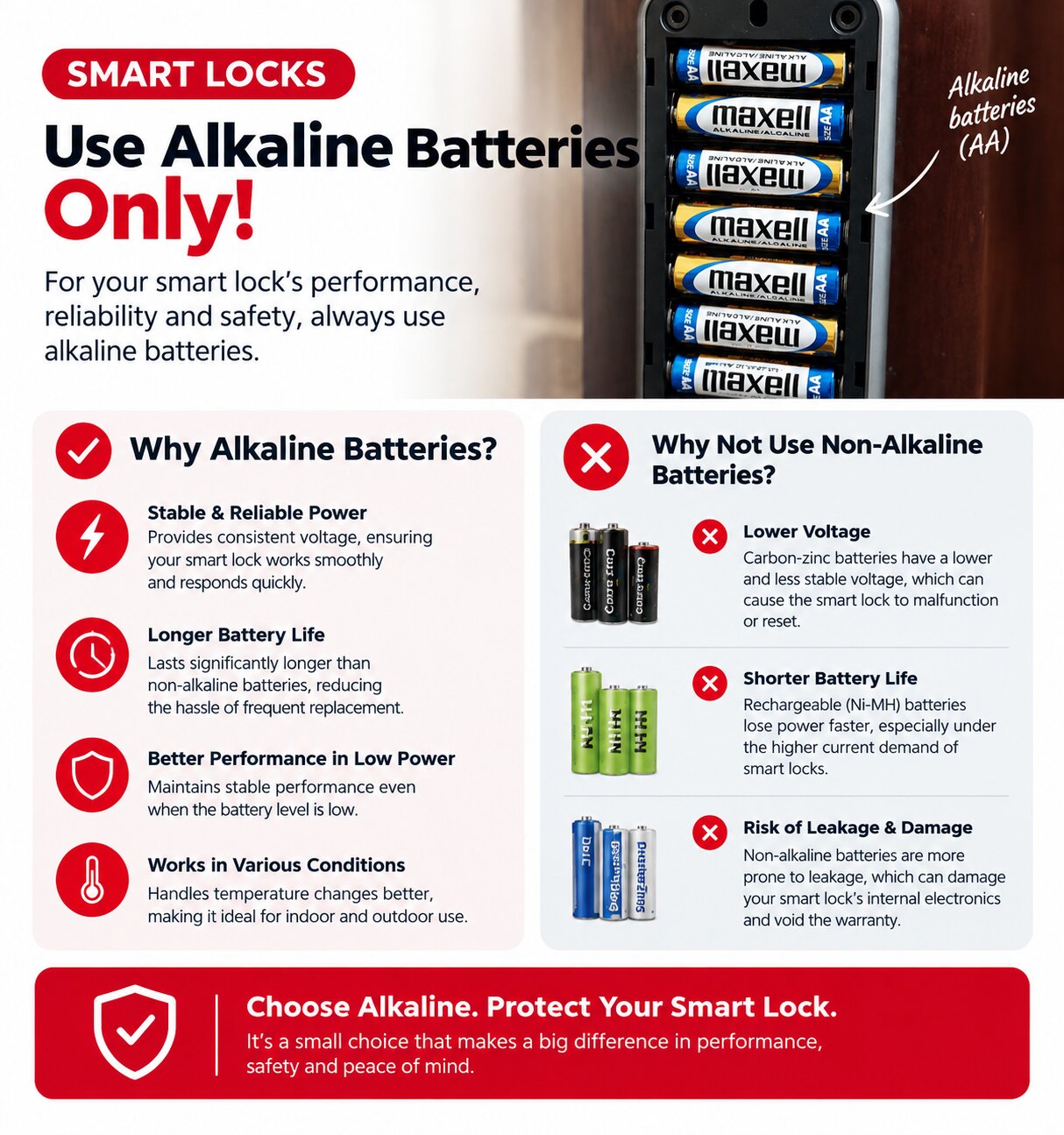
For reliable and consistent performance, we strongly recommend using high-quality alkaline batteries in your smart lock.
Using the correct type of battery can help prevent unexpected lockouts, poor performance and unnecessary battery replacement.
Why Are Alkaline Batteries Recommended?
1. Stable and Reliable Power
Smart locks require a stable power supply to operate their electronic components and motor correctly.
Alkaline batteries provide a relatively stable voltage throughout their useful life, helping the smart lock operate consistently when unlocking, locking and communicating with the user.
2. Longer Battery Life
Compared with many basic non-alkaline batteries, quality alkaline batteries generally provide better energy capacity for everyday smart-lock applications.
This means you can enjoy longer operating time before needing to replace the batteries.
3. Better Performance During Motor Operation
Unlocking a smart lock can require a short burst of power to operate the motor that moves the locking mechanism.
A suitable alkaline battery can provide the necessary power more reliably, helping reduce situations where the lock struggles to complete the locking or unlocking operation because of weak batteries.
4. More Suitable for Electronic Devices
Smart locks are electronic devices that can be sensitive to unstable or insufficient power.
Using a reputable alkaline battery brand gives you a more dependable power source and helps maintain the expected performance of the lock.
5. Fewer Unexpected Battery Problems
Battery failure can happen at the worst possible time—such as when you are trying to enter your home.
Using good-quality alkaline batteries and replacing the complete set when the battery level is low can reduce the likelihood of unexpected power-related problems.
Why Should You Avoid Non-Alkaline Batteries?
Not all AA batteries are the same. Although they may look identical and physically fit inside a smart lock, their chemistry and electrical characteristics can be different.
Carbon-Zinc Batteries
Carbon-zinc batteries are generally less suitable for smart locks because they typically have lower capacity and poorer performance under higher loads compared with alkaline batteries.
A smart lock may therefore experience shorter battery life or reduced performance.
Rechargeable Ni-MH Batteries
Rechargeable batteries such as Ni-MH can be useful for many electronic devices, but they are not automatically a suitable replacement for alkaline batteries in every smart lock.
A typical alkaline AA battery has a nominal voltage of around 1.5V, while a typical Ni-MH rechargeable AA battery is around 1.2V.
If a smart lock is designed around 1.5V alkaline batteries, using lower-voltage rechargeable batteries may result in:
- Earlier low-battery warnings
- Shorter usable operating time
- Reduced motor performance
- The lock shutting down earlier than expected
- Possible compatibility issues
Always follow the battery specifications stated by your smart-lock manufacturer. If the manufacturer specifically supports rechargeable batteries, then those batteries may be used according to its instructions.
What About Other Types of Batteries?
Lithium AA batteries can have excellent performance and a long shelf life, but they should only be used if your smart-lock manufacturer specifically approves them.
Do not assume that any AA battery is suitable simply because it fits physically inside the battery compartment.
The most important rule is:
Use the battery type and specification recommended by your smart-lock manufacturer.
For smart locks designed for alkaline batteries, choose good-quality 1.5V alkaline batteries from a reputable brand.
Important: Replace All Batteries at the Same Time
If your smart lock uses multiple batteries, we recommend replacing all batteries in the lock at the same time.
Avoid mixing:
- New and old batteries
- Different brands
- Different battery types
- Alkaline and rechargeable batteries
- Batteries with different capacities
Mixing batteries can cause uneven discharge and may affect the performance of the smart lock.
For best results, use a complete matching set of fresh alkaline batteries.
Do Not Mix Different Battery Types
For example, do not install:
❌ 2 alkaline + 2 rechargeable batteries
❌ 2 new batteries + 2 partially used batteries
❌ Alkaline + carbon-zinc batteries
❌ Batteries from different chemistries
Instead, use:
✅ A complete set of fresh alkaline batteries
✅ Same battery type
✅ Preferably the same brand and model
✅ Correct size and voltage according to the lock manufacturer’s specification
What Happens When the Batteries Are Low?
Never wait until the smart lock completely stops working before replacing the batteries.
Most modern smart locks provide a low-battery warning through an alarm, voice prompt, LED indicator or mobile application.
When you receive a low-battery warning, replace the batteries as soon as possible.
Many smart locks also provide an emergency power connection on the outside of the lock, allowing temporary external power to be supplied when the internal batteries are completely depleted. However, this feature varies between models.
Our Recommendation
Your smart lock protects your home, family and belongings. A small battery may seem insignificant, but it is one of the most important components keeping your smart lock operating.
For smart locks that specify alkaline batteries:
Choose quality alkaline batteries.
Replace the complete set when required.
Do not mix different battery types.
And always follow the smart-lock manufacturer’s battery specifications.
Choose the Right Battery. Keep Your Smart Lock Reliable.
A little attention to battery selection can help provide better performance, longer operating time and greater peace of mind.
Short disclaimer for the bottom of the article
Disclaimer: Battery requirements can vary between smart-lock models. Always refer to the manufacturer’s installation and user manual for the recommended battery type, voltage and specifications. The information above is provided as general guidance and does not replace the manufacturer’s instructions.